 by
by 
Threads for Work Boots and Heavy-Duty Footwear: Strength, Durability, and Performance
- September 30, 2026
- blog
When a normal shoe can’t keep up, work shoes and heavy-duty footwear come in handy. Footwear is likely to be… Read More
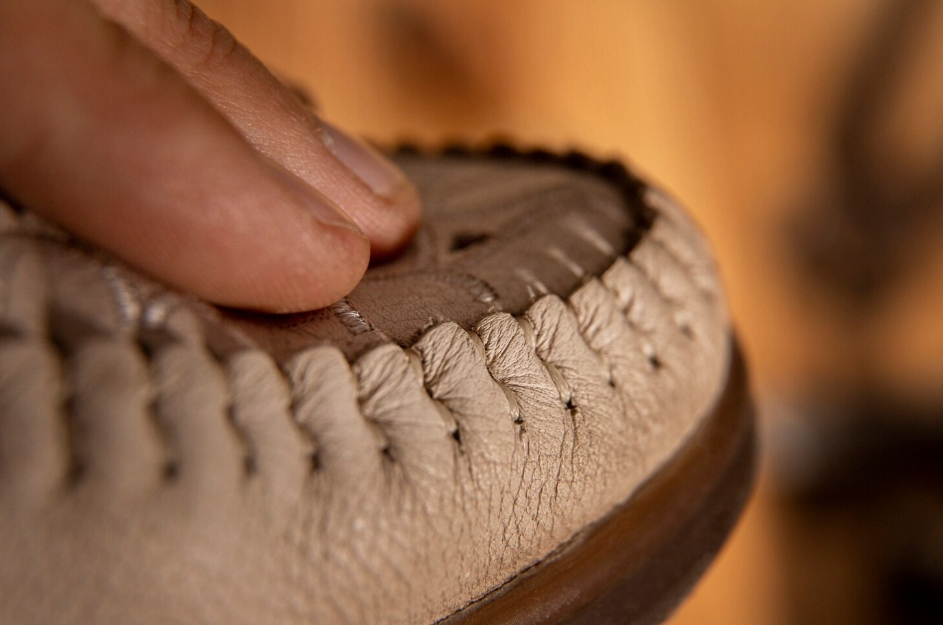
In footwear manufacturing, sewing machine thread is often a small component, but its performance can have a major impact on the durability and reliability of the finished product. Footwear seams are subjected to friction, bending, stretching, dampness, soil, and mechanical loads at all times. A weak seam may be caused by an eroded thread and can fail even if the upper threads are still in good shape.
That’s, therefore, why abrasion testing is a vital instrument for the choice of footwear sewing threads. An abrasion test is used to determine how the thread performs under repeated friction and can aid in selecting constructions that will perform better in specific applications of footwear, rather than relying solely on tensile strength and appearance.
Abrasion uses: When a surface rubs against another surface again and again. Sewing threads in shoemaking and in use in shoes can be abraded.
As thread goes through the needles, tension devices, thread guides, and thick masses of fabric during sewing. During this action at high machine speeds friction and heat are produced. After footwear is utilized, the thread can rub against the material around it, against other parts, or on external surfaces of footwear.
Many times, the abrasion over time can wear away the surface of the thread. Depending on the thread construction, this may result in:
Abrasion resistance is especially critical for seams subject to higher stresses, since they are subject to repeated motion over the life of the shoe.
One of the biggest problems with thread choices is that the emphasis is placed too much on tenacious strength. The strength of the thread is essential, but in itself it does not indicate good abrasion resistance.
A thread can carry a large static load but have degraded performance if rubbed or flexed in varying directions repeatedly. It is unlikely that only one kind of stress will be applied to the seams in footwear. They are subjected to internal stress, bending, rubbing, and cyclic action.
Abrasion testing is therefore useful in giving information different from that obtained by tensile testing alone.
For instance, both threads can have the same tensile properties, but the thread that is the most resistant to abrasion could yield much greater seam durability for an outdoor shoe or work boot.
Abrasion testing measures a thread and/or stitched seam’s ability to resist similar rubbing in a stipulated manner. The actual test method varies with the application and applicable laboratory or industry standard.
While it is in the test, a thread (bonded nylon thread) or seam is moved against a given surface under controlled conditions of friction. The test can gauge the number of abrasion cycles it takes for the thread to break or for some other predetermined failure point to occur.
Variations may be removed by testing under the following conditions:
The data obtained with the resulting immediate offers is an objective comparison of various thread constructions for manufacturers.
Importantly, the breeding of a cadaver dog should be based on the conditions that a dog will find when put to use in real shoes.
All shoe products don’t need the same level of abrasion resistance.
Appearance may be an important aspect of the performance for footwear, and moderate abrasion resistance may suffice for many seams for fashion footwear.
In sports and athletic shoes, seams are flexed and move over and over. The thread should resist being broken by repeated bending and stretching.
The thread can be used on hikes and in shoes for outdoor wear and may come into contact with dirt, water, rocks, grass, and other external abrasions. A significantly greater abrasion resistance might be of particular value.
Seams can experience high mechanical loads externally and extreme conditions in work and safety footwear. In extreme conditions, manufacturers may need special high-tenacity threads or bonded threads that can withstand the wear.
Another factor that relates to the size of thread and abrasion. Heavier threads often have a greater cross-sectional area and might be suitable for high-strength applications. But using the thickest thread suit is not necessarily the right choice.
Too large of a thread may result in bulky seams, an excessive number of needles, impact on machine operations, and a change to the look of the shoe.
Therefore, manufacturers need to take into consideration the item design, quality of the material, quality of seams, and ability to stitch the seams.
Thread Finish and Lubrication
The surface finish of a sewing thread may have a great effect on its sewing and abrasive characteristics.
Appropriate finishes help minimise friction between the thread and in-between the thread and fabric while sewing. This can help to reduce heat generation and surface damage during high-speed production.
The careful control of lubrication is also important. Lubrication that is too thin or too thick can lead to increased friction, and too much or too poor of a finish can damage the paper in the subsequent finishing stage.
Abrasion testing can help determine whether a particular thread finish provides the desired performance without creating other manufacturing issues.
Although individual thread testing provides valuable information, manufacturers should also evaluate complete stitched seams.
Interaction of thread and footwear material can change the behaviour of the thread. Abrasion performance may vary based on needle holes, stitch density, tension on thread, how the seams are created, and degree of flexibility of material.
This is why it is advisable for manufacturers to test:
This gives the appropriate idea of how the thread will work in actual manufacture.
Abrasion resistance should not be considered in isolation. There are a number of requirements imposed on a high-performing footwear thread.
In designing their products, manufacturers should consider combining abrasion results with testing for:
While an excellent abrasion-resistant thread, it may be less resistant to UV or chemicals and therefore may not be a good choice for outdoor or industrial footwear.
Therefore, a selection process should take into account the overall performance of the thread.
Using Test Results to Improve Manufacturing
Abrasion testing can also benefit manufacturers by helping them optimize their sewing process. If a thread is not performing well, the engineer has the option to determine if the difficulty is with the stitch density, sewing speed, engineering machine settings, needle selection, or thread construction.
Standardized sewing parameters can then be developed for each of the footwear materials, using production trials.
This can help minimize the breakage of threads, rework, seaming failures, and downtime in production while helping to achieve production consistency.
What many people aren’t aware of is that one of the biggest advantages of an abrasion-resistant sewing thread is enhanced footwear durability. If the upper wears out prematurely through the failure of critical upper seams, the upper can no longer be used.
Manufacturers can help prolong the life of shoes by choosing threads that can be more resistant to repeated abrasion and mechanical stress.
It also has a pro-sustainability effect. With more durable footwear, replacement happens less often, which will have a positive impact on reducing material use and thus environmental impacts during production.
For the manufacturers of footwear, using the abrading test is a great source of data to use when choosing sewing threads. It can be used to determine the different types of thread construction that are able to resist frictional movements, and it can also enable the revealing of performance disparities that cannot be ascertained by tensile testing.
A good way to do this is to consider the abrasion resistance along with tensile strength, elongation, flex fatigue performance, environmental resistance, and sewing action. Complete seams should also be tested in conditions simulating the type of application to which the manufactured seams will be put.